
1. Executive summary
The Spring Grants 2025 engagement programme aimed to capture qualitative feedback from underserved and marginalised communities, targeting Core20 populations. Local VCSE organisations were awarded grants to run community activities, engaging participants from diverse ethnic, socio-economic and health backgrounds.
Engagement focused on experiences of NHS services and healthy living behaviours, with a specific local focus on alcohol with one in three adults in the borough drinking over fourteen units of alcohol a week, higher than London and England.
Key cross-borough themes
- Access to NHS services
Many participants reported long waits for GP, specialist, and mental health appointments, alongside poor continuity of care and limited follow-up support. Disabled and migrant communities faced additional challenges navigating NHS systems, though some shared positive experiences of emergency care and compassionate staff.
- Language and communication barriers
Language barriers and lack of translated materials made it difficult for migrant communities to engage with healthcare services. Individuals with sensory impairments also experienced digital exclusion, leaving them uninformed about service changes and unable to access online systems.
- Mental health and emotional wellbeing
Loneliness, stress, and trauma were common across groups, particularly among neurodiverse individuals and refugees. Long waits for therapy and limited access to tailored mental health support were key concerns, with community organisations playing a vital role in providing safe and supportive environments.
- Challenges to healthy living
Despite awareness of healthy habits, many faced financial, time, and motivational barriers to maintaining them. Older adults and those with disabilities struggled with cooking and physical activity, while there was a need for more inclusive and affordable wellbeing activities.
- Value of community and social support
Community organisations were consistently praised for reducing isolation and promoting wellbeing. Attendees valued the emotional support, connection, and sense of purpose offered by local groups, which often provided more accessible and inclusive environments than clinical settings.
Alcohol specific insights
- Lack of awareness on ‘safe’ drinking levels and where to get support There was a gap in understanding around safe alcohol consumption and recommended units and where to get support. While there was awareness of the health risks associated with alcohol and recommended limits discussions revealed some confusion or misinformation.
- Quality of support services Those with experience of alcohol related support services were frustrated with the accessibility, responsiveness, and coordination of these services.
- Alcohol as a coping mechanism in the absence of other support People described using alcohol to manage emotional distress/mental health, loneliness, or trauma, indicating a need for more holistic support and information, particularly for young people, refugees and migrant communities.
- Cultural beliefs and sensitivities Cultural norms and beliefs shaped attitudes toward alcohol, often leading to low consumption amongst those participating in discussions. This also impacted on the depth and breadth of discussions with some people hesitant to talk openly about the subject.
Next steps
Overall, the report highlights barriers in Richmond to healthcare access and links between socio-economic pressures and health behaviours.
We will take the findings in this report, including those for alcohol, to the Richmond Health Information Group in September 2025 to agree next steps.
2. Introduction
This report details the feedback we received in Richmond borough during our SWL 2025 spring engagement programme. Through this we worked with community organisations primarily working with our Core20 populations and in our more deprived areas, providing a voice to the most marginalised and underserved. We offered grants of up to £550 to VCSE organisations to hold activities with these populations to help us understand these communities’ access to and experience of local NHS services, as well as their behaviours in maintaining healthy lifestyles.
Our approach for this phase changed to have more of a focus on gathering qualitative feedback, rather than sharing communication messages – as we did in the Winter phase. Funding where possible was based on health inequalities.
In each borough we also had a particular topic of focus. In Richmond it was alcohol. However, we also tried to keep the conversations quite broad – to really understand what was important to local people. We chose alcohol because recent data indicates that alcohol consumption in Richmond upon Thames is relatively high compared to national averages. According to the latest Public Health England profiles, approximately 25% of adults in Richmond report drinking at levels that increase their risk of harm. One in 3 adults in the borough drink over 14 units of alcohol a week, higher than London and England. There were an estimated 1400 dependent drinkers in the borough.1 This report builds on existing insight work undertaken by Healthwatch Richmond (2023) Public perspectives on healthy living in Richmond – a summary of the findings relating to alcohol are set out in appendix 1.
To support the move to more neighbourhood level work, we have presented the findings as follows:
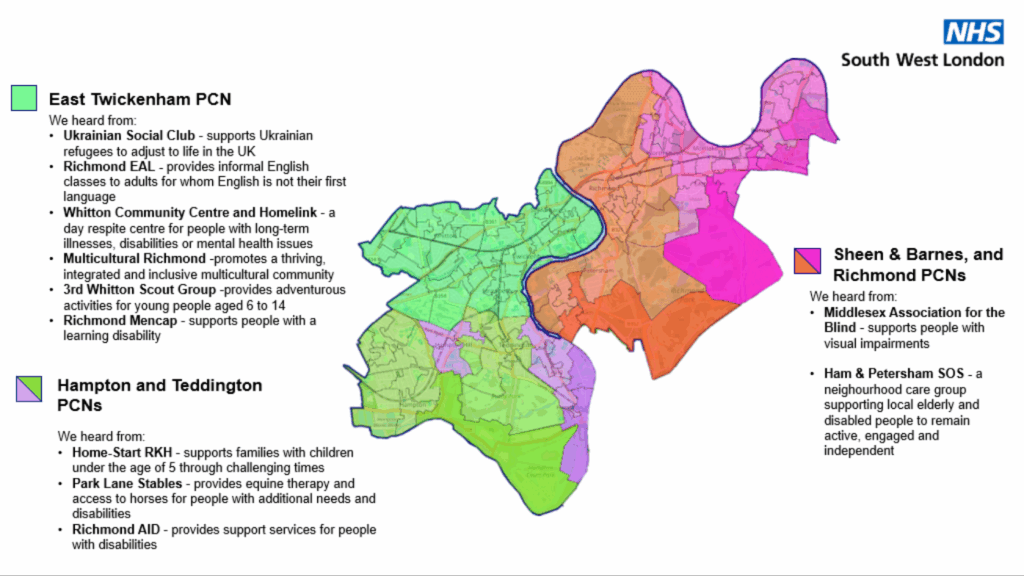
- at a neighbourhood level (groups of PCNs). We did this by mapping where organisations are based/activities took place to particular geographies. This does not mean that the organisations mapped to a neighbourhood work only in that area – however, it helped us to interrogate the data at a more local level.
- at a borough level for overall themes for health communities and then for alcohol.
3. Methodology
To support programme delivery and coordination, we worked with Richmond CVS who held trusted relationships with local groups and were able to provide knowledge and expertise to successfully deliver the work.
Grants were awarded based on who the organisation could reach and how closely it matched our target audiences, as well as their engagement approach.
Across south west London, we worked with 87 organisations reaching 6,019 local people. In Richmond borough, we awarded health communities grants to 11 organisations, conducted 37 activities and events with an estimated reach of 520 local people from across 37 ethnicities. Activities ranged from coffee mornings with refugees; walk and talk sessions for people with English as a second language to interactive games sessions for people with additional needs and disabilities.
Successful organisations were invited to attend an online training session to support them to collect insight in inclusive and accessible ways. Each group was asked to explore the following topics using prompts to encourage conversation: experiences of NHS services; how people stay healthy; knowing when to seek help and understanding other factors that shape people’s health and wellbeing. In Richmond we also asked questions about alcohol.
Following their event, organisations were asked to submit a summary of what they heard, together with quotes and photos. Where it was identified that more insight could have been shared or additional support was needed Richmond CVS followed up with 121 conversations with a sample of organisations.
4. Healthy communities insight: challenges and barriers
Findings by neighbourhood
An action from our winter engagement work was to start connecting our VCSE organisations with the emerging neighbourhoods so we have reviewed the healthy communities’ insights by neighbourhoods to inform developing neighbourhood health working. VCSE organisations taking part in the spring grants programme have been mapped to the neighbourhood where they are based; we are aware that local people may have attended activities from across the borough.
4.1 Hampton & Teddington Integrated Neighbourhood Team
This neighbourhood includes Hampton and Teddington primary care networks (PCNS) and covers the borough wards of Teddington, Hampton, Hampton North, Hampton Wick and Fulwell and Hampton Hill.
| Organisation | Activities | Who they spoke to (e.g. ethnicities, age, gender etc.) |
| Home-Start RKH – supports families with children under the age of 5 through challenging times | Hosted a number of individual conversations with parents during their weekly Family Groups | Parents of under 5s, majority female between 30-44 years of age. Some were parent carers. |
| Park Lane Stables - provides equine therapy and access to horses for people with additional needs and disabilities | Ran an interactive session with games at the stables. | People with additional needs such as mental health, autism or learning disability, aged between 21-64 from diverse backgrounds including Black British and Sri Lankan. |
| Richmond AID – provides support services for people with disabilities | Held two group conversations one with a focus on alcohol | People with a physical or sensory disability including sight and hearing loss, mental health and autism. Some were also carers. |
Key findings from these organisations:
Access to NHS care
Challenges to accessing NHS services, particularly in primary care relating to continuity of care, feeling respected and understood, and support after leaving hospital.
- Lack of continuity: An attendee at Richmond Aid finds it difficult having to see someone different at each appointment “No-one really knew her at the GP practice as every time she goes, she sees someone else,”. There was an ask for a return to having a named GP for complex cases with regular reviews.
- Support after leaving hospital: A mother described her experience after her child’s hospital stay which was a positive experience but on going home she felt she “had to do a lot herself” and was “Very disappointed that no service after child left hospital” (Home-Start RKH).
- Discharge pressure: A patient shared that they had felt “really vulnerable” after being discharged too early following surgery, despite their consultant later saying they shouldn’t have been discharged the same day. They had felt pressured to find someone to be at home with them while not feeling well enough to go home. (Richmond AID).
- Discrimination and poor treatment: a parent described a distressing experience with GP practice highlighting poor communication and discrimination towards someone with a disability. They reported having to now record their appointments to prove “how rude/discriminatory” the staff were at the practice and said they “felt unheard” (Home-Start RKH).
- Challenge of clinical settings for people with additional needs Significant’ challenges around accessing clinical settings for reasons including challenges with travel, COVID-related phobias, and emotional/social barriers. One person shared that they attend appointments ‘while discreetly drinking cider to cope’ (Park Lane Stables)
- Gaps in support for autism and mental health Richmond Aid identified that there is a gap in the support available for people that are neurodiverse, mainly autism, and who are receiving mental health services.
- Adult ADHD and Autism Richmond AID reported long waiting lists for assessment and diagnosis for ADHD and Autism – often years. As a result, some people will access private care to now be told that NHS no longer accepts a private diagnosis, and they need a NHS one. People are very frustrated as this affects access to support and medication.
Despite these challenges, some attendees, particularly at Park Lane Stables expressed appreciation for NHS staff and emergency care. There was a sense that for some they only accessed NHS care in an emergency or crisis which could indicate a need for great awareness of seeking help earlier and around prevention.
“Saved my son’s life.”
“My son has Down Syndrome and sometimes becomes seriously ill quite quickly and never had to wait in A&E we can’t thank them enough.”
“Very kind heart scan at Kingston Hospital Cardiac Unit.”
“Her pharmacy… saved her another hospital trip and she hasn’t had the issue since.” (Richmond Aid)
Long waits for appointments
Long waiting times for both routine and specialist care were a concern affecting people’s timely access to care. Waits described as ‘too long’ and ‘a big issue.’
- People shared experiences of delays including children’s speech and language therapy “Wait time can be very long, 7-month delay,” from a parent at Home-Start.
- Richmond Aid clients reported “6 to 12 month waiting list for therapy,” which they felt was unacceptable for mental health support.
- Emergency care delays including a parent at Home-Start “Ambulance waiting times are terrible” who had been told to drive herself to A&E on three occasions as it would be faster.
Language and communication barriers to health care
While not always explicitly about language, poor communication and lack of follow up were highlighted which led to people feeling dismissed, misunderstood or not supported.
- Feeling unheard: “Felt unheard,” said one attendee, who resorted to recording appointments due to discriminatory treatment (Home-Start RKH).
- Lack of follow up information: a parent shared receiving “No information what to do after vaccination… child traumatised after experience.” and then no reply from healthcare professionals after reaching out for help except asking to leave a review. (Home-Start)
- Need for clearer information: There was frustration with being expected to manage complex health information without adequate support (Richmond AID)
Challenges for healthy lifestyles
While many people demonstrated strong awareness of healthy living habits, they also faced emotional and practical barriers to maintaining them.
- Use of green spaces and walking: Participants described walking and spending time in parks as key strategies for managing stress and maintaining wellbeing. “Green spaces and groups help her to feel well… walking as a means to fight stress.”
- Community and social support: A strong theme emerged around the value placed on community-based and social support and non-clinical environments for people’s health and wellbeing. The positive impact community organisations can have on people’s mental health and in reducing loneliness and making social connections. “The best thing: I got referred to Home-Start” However there was a need for expanded activities timetable/drop-ins for children’s centres, to help parents and parent-carers ‘get out’ to take breaks (Home-Start RKH)
However, it was noted that while community recovery groups (non-clinical) were helpful they can sometimes lack the professional safeguarding oversight which could pose risks. (Richmond AID)
Mental health and emotional wellbeing
Mental health challenges were common within these organisations, with attendees highlighting both the need for support and the barriers to accessing it.
- Loneliness and neurodiversity: “Many people we support are very lonely. There is a big gap in support for people that are neurodiverse, mainly autism” (Richmond AID).
- Emotional validation: Feeling listened to by GPs or supported by community groups was crucial for mental wellbeing.(Park Lane Stables)
- Practical barriers: Difficulties accessing clinical settings due to travel issues, COVID-related fears, and emotional or social barriers.
4.2 Twickenham, Whitton & Heathfield Neighbourhood
This neighbourhood includes East Twickenham primary care network and covers the wards of Twickenham Riverside, St Margarets & Twickenham North, South Twickenham, Heathfield, Whitton, West Twickenham, Fulwell and Hampton Hill.
Half of the funded organisations mapped against this neighbourhood work with communities where English is not always their first language. Together with Mencap, another specialist organisation, they had attendees who came from wards outside of the neighbourhood area including East Sheen, Barnes, North Richmond, Ham, Kew, and Hampton North.
| Organisation | Activities | Who they spoke to (e.g. ethnicities, age, gender etc.) |
| Ukrainian Social Club - supports Ukrainian refugees to adjust to life in the UK | Held 3 group activities including a coffee morning, an online survey and individual conversations. | Members of the local Ukrainian community ranging from 18 to 85+ years. Some with a disability including sight or hearing loss and mental health. |
| Richmond EAL – provides informal English classes to adults for whom English is not their first language | Held 3 discussion sessions and a walk and talk session with their learners. | People were from diverse ethnic communities and were aged between 30 – 59 years. Some had a long-term condition and some were carers. |
| Whitton Community Centre and Homelink - a day respite centre for people with long-term illnesses, disabilities or mental health issues | Held a VE celebration and wellbeing day. | People were from a number of different communities including Chinese and Filipino aged between 45 – 59 years. |
| Multicultural Richmond -promotes a thriving, integrated and inclusive multicultural community | Hosted group discussions at their Heathfield social club. | People were from diverse communities including Bangladeshi, Chinese, Turkish and Afghan and aged between 60 – 85+ years. Some had long term conditions such as diabetes, heart disease and osteoporosis; others had sight or hearing loss and learning disability. Some were carers. |
| 3rd Whitton Scout Group -provides adventurous activities for young people aged 6 to 14 | Held conversations with parents and young people over a weekend repairing the scout hut. | People aged between 18 – 59 years from diverse communities. Some had a long-term condition. |
| Richmond Mencap - supports people with a learning disability | Hosted a healthy cooking session. | People from Turkish and White ethnic backgrounds, aged between 25 – 74 years. Some had sight or hearing loss and others had long term conditions such as epilepsy, livery issues or high blood pressure. |
Key findings from these organisations:
Difficulty accessing NHS care
Access to NHS services varied across the organisations, with some people praising their GP while others faced significant barriers. Issues included long waits, poor communication and follow up leading to feeling disappointed and let down by services . For those with language barriers, more complex needs or disabilities, navigating the system was especially challenging.
- Dentistry: Difficulties accessing dental care and the cost of treatment was highlighted by some with one person sharing they were deleted from the dentist’s register for missing one appointment (EAL USC)
- Navigation and communication between services: There was frustration with trying to navigate the NHS when you are unwell, new to the NHS or English is not your first language. People talked about lost referrals and the need to improve communication between their GP and the hospital. (MCR). Others raised the issue of not being able to return telephone calls from hospital departments because they use undisclosed numbers.
“Ability to phone back missed calls – e.g. different hospital departments and outpatients have undisclosed numbers so cannot return a call.”
“Hospitals don’t take referrals seriously and the referral is lost in the process.”(Multicultural Richmond)
- Online services: While some used the NHS app and online systems for appointments, reminders and prescriptions some older people asked for alternatives to online access for those who do not have digital skills (MCR).
- Community pharmacy: There was generally positive feedback about community pharmacy however both Homelink and Ukrainian Social Club attendees highlighted issues with delivery of medication and the need to improve prescription management. Some people are receiving incomplete medication orders resulting in them having to go through the ordering process again wasting time for patients, doctors and pharmacies.
- Experience of people with a learning disability who felt positively about their local hospitals and GP services: of being treated with respect and dignity when they require care (all were receiving support from key workers/family). The Richmond wellbeing service and the Recovery College were cited as valuable services.
- Lack of clarity around entitlement to NHS support attendees at the Whitton Community Centre and Homelink event highlighted that friends were not aware of their entitlement to support from the NHS e.g. buying continence pads instead of contacting the continence team for support.
Long waits for appointments
Long waiting times for hospital appointments, diagnostics, and mental health services were a recurring concern.
- Delays impacting on health: These delays often led to worsening health conditions and emotional distress.
“It can get so much worse while I’m waiting for my next appointment or to be referred.”
I have protrusions in my back. My GP referred me for an MRI, but the hospital cancelled it. I still can’t prove my condition at work.”
“I had abnormal blood test results… still haven’t received any treatment.” Ukrainian Social Club.
Older people talked about long waits for physiotherapy, while others shared their difficulties getting a GP appointment, or diagnostics (MRI and ultrasound) and had concerns around the long waits for mental health support
“It’s hard to get support when you need it. The real issue is wait time.’ (3rd Whitton Scouts)
“Availability of doctor’s appointment – usually 7–10 days to get an appointment.” (Whitton Community Centre & Homelink)
- Awareness and education there was a need to do more to encourage and promote regular health checks, and services such as NHS 111 and community pharmacies as the first point of contact for people with non-urgent health concerns.
Language/communication barriers to healthcare
Language and poor communication were cited as barriers to accessing care, especially for migrant and refugee communities. Those affected described feeling misunderstood, dismissed, or unable to communicate symptoms effectively.
- Interpreters and translation: Language barriers and lack of access to interpreters and translated information affected people’s confidence in and access to services. “Provide better language support – people struggle to explain symptoms properly in a 10-minute appointment.” Ukrainian Social Club. A learner at Richmond EAL knew where to go for help but language was a barrier in the appoint. “I know where to go for help but cannot understand the doctor.” EAL Accessing translations and interpreters for some languages was more challenging and should be addressed. “Chinese translation (Cantonese) is not easy to get and can’t get face-to-face translation.” (Multicultural Richmond)
However, there was positive feedback from Richmond EAL of some doctors using Google Translate to communicate with patients.
- Discrimination and staff behaviour: Experience of staff coming across as rude and racist if English is not the patient’s first language (EAL). This affects people’s trust and confidence in services and potentially less likely to try and access services in the future.
“Reception staff can be rude and impatient… they can be impatient and come across as racist.”
“Radiologist once said ……….. that she didn’t like her wearing a hijab and told her to go away and make another appointment with a translator.”
- Better communication at registration: To overcome the challenges of navigating the NHS suggestion to provide clear information about how to use the NHS and the GP practice when you register first with your GP practice. “Better communication at registration, especially for non-British citizens.”
Challenges for healthy lifestyles
Most people understood the importance of healthy living but faced barriers such as cost, time, and lack of motivation to maintain a healthy diet and exercise.
“I would like to follow up on hobbies – but time and finances get in the way.” (Homelink & WCC)
Other factors that impacted on people’s health and wellbeing included loneliness, traffic and pollution, news, family and time pressures. Some people shared how stress, isolation, and financial pressures could negatively impact their wellbeing.
Social connection, access to green spaces, and cultural activities were seen as vital to mental health. For some volunteering provided a sense of purpose. A common theme was the value placed on community groups.
“Richmond parks are some of the best medicine, I love them!” (USC)
“Coming to Multicultural Richmond makes me relaxed, calm and happy.”
“Life is good when with friends.”
Some Mencap attendees explained having to rely on professionals or family members to help them access social activities which meant it wasn’t always possible to do what they wanted to do. For others, the booking systems and planning in advance were challenges when booking activities such as swimming resulting in them stopping the activity.
4.3 Richmond, Ham, Kew & Barnes Neighbourhood
This neighbourhood includes Sheen & Barnes and Richmond PCNs and covers the wards of South Richmond, Ham, Petersham & Richmond Riverside, North Richmond, Kew, Twickenham Riverside, Mortlake & Barnes Common, St Margarets & North Twickenham, East Sheen and Tudor (Kingston borough)
| Organisation | Activities | Who they spoke to (e.g. ethnicities, age, gender etc.) |
| Middlesex Association for the Blind - supports people with visual impairments | Hosted a discussion group as part of their regular support activities. | People from Indian and white ethnic backgrounds aged between 45 – 84 years. |
| Ham & Petersham SOS –a neighbourhood care group supporting local elderly and disabled people to remain active, engaged and independent | Held conversations during four of their regular activities e.g. Monday Morning Wellness and Fish & Chip Friday. | People from white ethnic background aged between 45 – 90+ years. Some had a disability such as sight loss, hearing loss, mental health and autism. Some were also carers. |
Access to NHS Care
While some attendees such as at Ham & Petersham SOS for Lock Road Surgery – initially expressed satisfaction with their GP services – further discussion prompted challenges around getting through to GP practices and satisfaction dependent on which GP you see.
“It’s hit and miss depending on what GP you see.”
“You can never get through and when you do it will say 20 calls waiting – Seymour House surgery”
“Great surgery. Very helpful – even the receptionists – Lock Road surgery “ – Ham & Petersham SOS
“If you are over the age of 65 you are just a number.” – Middlesex Association for the Blind
Discussions revealed significant barriers to accessing broader NHS services, especially for those with a disability or sensory impairment. Members of the Middlesex Association for the Blind described systemic barriers to accessing care.
“We have great difficulty accessing the services because we are all visually impaired.”
They struggle with both digital and telephone systems.
“I cannot do this new triage system on the computer. I am blind, you need to help me”
“There are too many buttons to press, and I struggle to do that.”
Transport: A member at Ham & Petersham SOS explained he was having difficulties accessing chiropody services due to changes to NHS transport eligibility. Another shared about asking at Kingston Hospital for transport home and told ‘she’d probably be waiting hours.’
“Blindness is no longer a criteria for NHS transport and he struggles to get there.”
Language/communication barriers to health care
Communication barriers were a particular issue for visually impaired individuals who struggled with digital systems and as a result digitally excluded and feeling uninformed about service changes.
“No one in the group makes use of the NHS app or online services… because they cannot use technology in this way.”
“They closed down the low vision clinic without letting any of us know.” Ham & Petersham SOS
“We were all signed off as case closed with no explanation.” – Middlesex Association for the Blind
Long waits for appointments
- Hospital waits and cancellations Long waiting times and administrative issues were recurring concerns, particularly for hospital services. While GP appointments were generally accessible, hospital delays and cancellations were frustrating.
“I have no faith in Kingston Hospital. Queen Mary’s is much better.”
“It feels like the system is broken.” – Ham & Petersham SOS
“There doesn’t seem to be enough connection between the surgeries and the hospitals in Richmond.” – Middlesex Association for the Blind
Attendees reported lengthy delays and administrative issues with getting appointments. One person described being told “it’s up to them to chase for cancellations” when their cardiology appointment at Kingston Hospital was pushed back a year from August 2025 to September 2026. (SOS). A member of Middlesex Association for the Blind shared that after waiting over a year for an appointment with the Royal Eye Hospital found out they would need to wait a further year for a referral as the service had lost their file. Others had similar experiences.
“I was on the waiting list for 2 years for a referral. After 1 year of waiting, I discovered that they had lost my file.”
Attendees at Ham & Petersham SOS shared their experience of increasing wait times to be seen at Kingston Hospital including 2-3 hours at the Royal Eye Hospital; spending all night in A&E after being missed and not referred onto the correct team and similar waiting hours in A&E after a fall with no one checking on them.
- Dentistry: Long waiting lists for dental treatment had resulted in some having to seek treatment privately. Others were concerned about the lack of emergency dental appointments at weekends and at night “no one available” (Ham & Petersham SOS)
Challenges for healthy lifestyles
Attendees understood the importance of healthy eating and exercise but faced practical barriers to implementing these habits, especially those living alone or with a disability.
“It’s easier for me to grab a packet of crisps than make a sandwich.”
“I don’t like cooking so use ready-made food.”
“Cooking for one is difficult.” – Ham & Petersham SoS
MAB attendees highlighted the need for adaptation and support to look after their wellbeing. “As someone who is losing their sight, I know that it is all about modification… Once I accept and start modifying, my mental wellbeing improves.”
- Social connection and the value of local community groups and activities was highlighted as vital for mental wellbeing.
“Going out and meeting other people is important.”
“Don’t get stuck in your home, go to places.” – Ham & Petersham SOS
“Coming to this monthly social club is really important to them.”
However, some people were unsure who to turn to if they were feeling stressed and there are barriers to taking part in activities if you have a disability.
“I wouldn’t know where to go if I was stressed” Ham & Petersham SOS
“It is hard to get around and to appreciate places and the environment… you need to wait until someone comes to help you.” – Middlesex Association for the Blind
5. Borough wide themes
Several consistent themes emerged across all neighbourhoods, reflecting both systemic issues and the vital role of community support.
5.1 Access to NHS services
A recurring concern across all organisations was the difficulty in accessing timely and consistent NHS care. Attendees frequently described long waiting times for appointments for primary care (GPs) specialist, and mental health services. For example, Richmond AID highlighted the frustration of individuals waiting years for ADHD and autism assessments, only to be told that private diagnoses were no longer accepted by the NHS.
Poor continuity of care and follow-up was another issue raised. People often felt they were see different professionals without a clear understanding of their history or needs. One parent supported by Home-Start RKH shared how, after her child’s hospital discharge, she felt unsupported, having to manage follow-up care on her own. Similarly, a participant from Richmond AID described being discharged too early after surgery, feeling vulnerable and pressured to find someone to care for them at home.
Another concern was difficulties navigating NHS systems, especially for disabled and migrant communities. Ham & Petersham SOS shared frustrations with NHS transport eligibility and long wait times to be seen when in the hospital. Multicultural Richmond highlighted issues with lost referrals and poor communication between GP and hospital service, further complicating access to care.
In contrast, others shared their appreciation for NHS staff, particularly in emergency settings. Park Lane Stables and Richmond AID both shared positive stories of life-saving interventions and compassionate care, highlighted the variability in patient experiences.
5.2 Language and communication barriers
Language and communication challenges which disproportionately affected migrant communities and individuals with sensory impairments. Organisations such as Richmond EAL and Multicultural Richmond reported that many attendees struggled to understand healthcare professionals during appointments, although some praised doctors who used tools like Google Translate to help with communication. Multicultural Richmond highlighted the lack of access to Cantonese translation and shared accounts of discriminatory treatment linked to language differences. This often led to feelings of being dismissed or misunderstood.
Digital exclusion was also a concern, especially among visually impaired individuals supported by the Middlesex Association for the Blind, who found online and telephone systems inaccessible and felt left out of important service updates.
5.3 Mental health and emotional wellbeing
Mental health emerged as a common concern, with many describing feelings of loneliness, stress, and emotional distress often exacerbated by trauma or neurodiversity. Richmond AID identified a significant gap in support for neurodiverse individuals, particularly those with autism, who often struggled to access appropriate mental health services. Long waiting times for therapy were common, with some reporting delays of up to a year.
The important role of community support in supporting emotional wellbeing came through strongly. Park Lane Stables for example providing a supportive space for people with additional needs.
5.4 Challenges to healthy living
While there was a strong awareness of the importance of healthy lifestyles, many attendees faced practical barriers to maintaining them. Financial constraints, time pressures, and lack of motivation were frequently shared. At Ham & Petersham SOS, older people spoke about the difficulty of cooking nutritious meals when living alone or managing a disability. For some Richmond Mencap attendees relied on carers or professionals to access physical activities, limiting their independence and spontaneity. Whitton Community Centre and Homelink reported that time and financial limitations prevented people from pursuing hobbies and exercise, despite their awareness of the benefits.
Despite these challenges, there was a clear desire to engage in healthier behaviours. People valued access to green spaces, with one attendee from the Ukrainian Social Club describing Richmond’s parks as “the best medicine.” However, there was a need for more accessible and inclusive activities
5.5 Value of community and social support
Perhaps the most consistent and positive theme was the vital role of community organisations in promoting health and wellbeing and reducing isolation. Across all neighbourhoods, attendees placed a high value on the support, connection, and sense of purpose provided by local groups. Home-Start RKH was described as a lifeline for parents, who valued the emotional support and social connection of the groups. While Multicultural Richmond offered a welcoming space for older adults from diverse backgrounds who described the social club as a place of calm, happiness and belonging. For some people such as those attending Park Lane Stables community groups provide a non-clinical environment which is preferred and less challenging for some with additional needs.
6. Alcohol: awareness, attitudes and behaviours
As part of the wider discussion about the key behaviours or actions that might help people to live a healthy lifestyle and prevent illness, some questions were included specifically about alcohol. These related to people’s understanding of the safe consumption and risks related to alcohol; their reasons for drinking if they did and general attitude towards alcohol. The key findings across organisations are set out below:
6.1 Lack of awareness on ‘safe’ drinking levels and where to get support
Across several groups, there was a clear gap in understanding around safe alcohol consumption and recommended units and where to get support. While there was awareness of the health risks associated with alcohol and some participants believing they knew the limits, further discussions revealed some confusion or misinformation.
- Richmond AID found that “none of our group had ever gone through their alcohol units with a professional,” and the NHS Better Health leaflet was described as “very confusing.” One participant admitted, “First time I’ve heard of this [RCDAS], the doctor didn’t tell me about it.”
- Richmond Mencap shared that while some drank socially, “I do drink once or twice a week and like going to my local to see my friends.” Attendees were not completely aware of the recommended alcohol limits, and needed the information provided explained during the session. The few at Ham & Petersham SOS who did drink, did so at family celebrations and gatherings such as weddings and funerals. One attendee reflected “It’s a major part of socialisation amongst adults”
- Richmond EAL Friendship Group noted that “all clear about how max 14 units of alcohol per week” after watching an educational video but also highlighted that “more warnings and advice should be given about dangers of alcohol.”
- Multicultural Richmond reported that participants “knew their limit and thought it was about a glass of wine per day,” but this was based on assumption rather than formal guidance. For others they were comfortable with moderate alcohol use and that it was not harmful “In my opinion, drinking red wine occasionally is not harmful to health… but I don’t drink alcohol at all due to certain health problems.” – Ukrainian Social Club
- There was some confusion on how to get support for alcohol issues, at 3rd Whitton Scouts it was noted that “you wouldn’t really know where to go to seek support with drinking alcohol,” and that the NHS App lacked information on signs and symptoms. Some attendees at Richmond Mencap were aware their GP could help but did not have direct experience of this.
- There was appreciation for the information provided on safe alcohol consumption, recommended units and local support.
6.2 Quality of support services
Those with experience of alcohol related support services were frustrated with the accessibility, responsiveness, and coordination of these support services.
- Richmond AID highlighted long waits which can be demoralising and poor communication: “Too long of a wait for referrals, 2–3 months,” or longer and “There’s a lack of connection and communication within support services.” One attendee shared, “I was put on tablets for stopping alcohol use but had never been referred to a support organisation.”
- An attendee at Richmond AID described how “psychiatrist at St George’s cancelled my upcoming session because they thought I was still using drugs, they did not communicate with my groups” despite being clean for three months— highlighted the lack of coordination between services. Another who was positive about the treatment they had received from Richmond Community Drug & Alcohol Service (RCDAS), also had complex mental health and housing issues and felt that there wasn’t any linkup between these services.
- There were concerns around the availability of alcohol support services in the borough. “there’s nowhere to go in Richmond” and that the local service needed raise its profile in the borough “There’s a lack of advertising I would not know where to go. Some thought that RCDAS had merged with Wandsworth services and did not offer support locally and had to travel to Clapham Junction. “RCDAS since merged Richmond and Wandsworth it has gotten worse, volunteers only know about Wandsworth services. Clients had to complain and then they started knowing more about Richmond.”
- One attendee at Richmond Aid was very upset as they felt the treatment options offered by RCDAS were very limited – only groups and far away (Clapham). They have mobility issues and didn’t feel confident in groups as they felt embarrassed. Another didn’t want to access support as he felt that all treatment options are about ‘giving up’ alcohol rather than cutting down and he would be open to support around cutting down and attending community groups.
- Attendees at Richmond AID also shared that they felt there was a lack of available information about support and a gap in support from professionals addressing alcohol use with them. There was a sense that it was brushed over rather than addressed; that GPs were reluctant to engage about alcohol use and were not aware of the support available. Some were not aware of RCDAS until they were referred later by mental health services. “First time I’ve heard of this [RCDAS], the doctor didn’t tell me about it” (person who lives in Barnes) One attendee in their 50’s shared how none of the health professionals they were in contact with including their GP had picked up on alcohol issues as they had been drinking heavily since they were 18. They were getting support for their mental health, but no professionals had addressed their alcohol issues even though they were open to getting support.
6.3 Alcohol as a coping mechanism in the absence of other support
Several attendees described using alcohol to manage emotional distress/mental health, loneliness, or trauma, indicating a need for more holistic support and information, particularly for young people, refugees and migrant communities. There was an ask for more education around mixing alcohol and medications.
- More support for other substance misuse such as marijuana consumption which Ukrainian Social Club members saw as a growing concern and stop smoking.
- People managing complex health conditions said that in comparison, safe alcohol consumption was not a priority for them, an attendee at Middlesex Association for the Blind shared “they have far greater things to worry about than that.”
- A participant from Richmond AID said, “I drank due to loneliness,” and expressed frustration that “all treatment options are about ‘giving up’ alcohol rather than cutting down.”
- Park Lane Stables RDA captured a range of views: “Alcohol makes me calm,” “Drink is not good!” and “I visited the GP – I drunk a bottle of wine a day.” Reflecting unidentified dependency and efforts to seek help.
- Ukrainian Social Club CIC found that “some drink alcohol to boost their mood… others drink because of mental health challenges brought on by stress, trauma, or the ongoing war in Ukraine.” One attendee shared, “Alcohol is my go-to; it makes me feel calm,” while another described becoming alcohol-free and reversing diabetes, showing both the risks and potential for recovery.
6.4 Cultural beliefs and sensitivities
Cultural norms and beliefs shaped attitudes toward alcohol, often leading to low consumption amongst those participating in discussions. This also impacted on the depth and breadth of discussions with some people hesitant to talk openly about the subject.
- Richmond EAL Friendship Group and Multicultural Richmond reported that most attendees did not drink due to cultural or religious reasons. “I have a bad attitude towards alcohol. I am also against it being sold to children.”
- Ukrainian Social Club reflected that there is a stigma around drinking, and some may feel ashamed or not able to share their drinking habits openly even though they may only drink occasionally.
- A learner from Richmond EAL reflected following their session “I learned about alcohol suffering. I know now the safe levels of alcohol I can get information from GP or 111,” showing that education and information can change perceptions.
- There was also a view that “alcohol is a problem in Richmond… because it is a rich borough,”
7. Next steps
The findings on alcohol, together with relevant findings from Healthwatch Richmond’s work on healthy lifestyles will be going to the Richmond Health Improvement Group in September 2025 to agree next steps.
8. Appendices
Appendix 1: Review of existing insights
Healthwatch Richmond’s report (2023) Public perspectives on healthy living in Richmond (2023) provides insights into local residents’ attitudes, motivations, and barriers to adopting healthy lifestyles. The key insights in relation to alcohol are:
- Attitudes: Many residents acknowledge the health risks associated with alcohol consumption but often underestimate the impact of their drinking habits. There is a general awareness of the need to moderate alcohol intake for better health.
- Motivations: Health concerns, such as the desire to avoid liver disease and other alcohol-related conditions, motivate some residents to reduce their alcohol consumption. Social influences, including family and friends, also play a role in encouraging healthier drinking habits.
- Barriers: Common barriers to reducing alcohol consumption include social/peer pressure that encourages drinking, stress, and a lack of awareness about safe drinking levels. Some residents find it challenging to change long-established drinking habits. Even with support many would find it difficult to change behaviour due to social pressure and settings, as well as cost and availability of non-alcoholic drinks.
- Information and support: Residents expressed a need for more accessible information and support services to help them make informed decisions about alcohol consumption. There is also a call for more community-based initiatives to promote healthy lifestyles.
Appendix 2: Mapping funded organisations by Neighbourhood